


Foreign-trade zones (FTZs) are designated sites within the United States where foreign and domestic merchandise is considered to be outside the U.S. customs territory, allowing companies to defer, alter or in some cases, eliminate duties. Foreign-trade zones give companies flexibility in the way they operate their business. By operating through an FTZ, a company can import components duty-free, assemble a product and re-export it, all without having to pay duties. Duties are only paid if the finished product enters the U.S. Commerce, reducing the need to use Duty Drawback. In some cases – and even then, the company can choose if it’s of greater financial benefit to pay duties on only the individual imported parts or on the finished product. Foreignt-trade zones are shown to stimulate trade, support jobs, enhance exports and engage U.S. business in international trade. The program is designed to lower the cost of doing business and stimulate economic growth and development in the U.S. The use of FTZs helps companies maintain the cost of U.S.-based operations and keep pricing competitive compared with foreign counterparts.
Save money on international trade
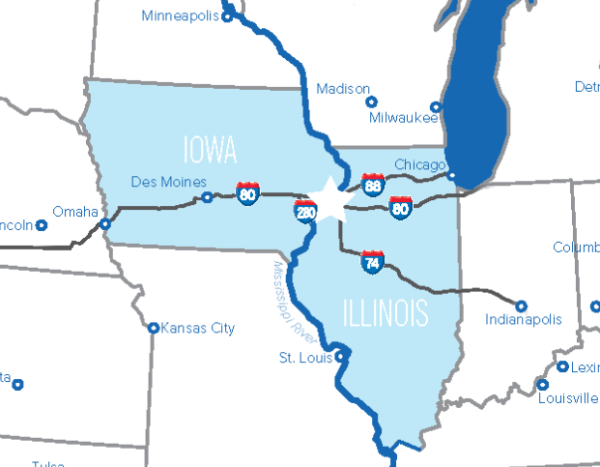
QC, That's Where you save money, and gain efficiencies and flexibility in operating your business. The Quad Cities has a designated Foreign-Trade Zone #133 (FTZ). Businesses located within 60 miles or 90 minutes of the Quad Cities Port of Entry can apply to operate in our FTZ and defer, alter or sometimes eliminate duties on foreign and domestic merchandise.
Counties within this service area include:
- Henderson, Henry, Mercer, Rock Island and Warren Counties in Illinois
- Cedar, Clinton, Des Moines, Dubuque, Henry, Jackson, Johnson, Jones, Lee, Louisa, Muscatine, Scott and Washington Counties in Iowa
What is a foreign-trade zone?
Eight ways FTZ can save your company money
The FTZ program allows U.S.-based companies to defer, reduce or eliminate customs duties on products admitted to the zone. The following are some of the benefits the FTZ enables.
1. Duty Deferral: Customs duties are paid only when merchandise is shipped into U.S. Customs and Border Protection territory. Inventory held in an FTZ is exempt from duty payment until shipped, which can provide companies with significant operational cash flow relief.
2. Duty Elimination: No duties are paid on merchandise re-exported from an FTZ, or on merchandise that is defective, damaged or obsolete, or on waste or scrap.
3. Elimination of Drawback: The duties paid on exported merchandise may be refunded through a process called drawback, however, the drawback law is complex and expensive to administer. Through the use of an FTZ, the drawback process and cost are eliminated.
4. Inverted Tariff: Users may elect a zone status on merchandise admitted to the zone. Importers may pay the duty rate applicable to either the parts or the finished product, whichever is lower.
Example: A foreign-trade zone user imports a motor, which carries a 5.3% duty rate, and uses it in the manufacturing of a vacuum cleaner, which has a 1.4% duty rate. When the vacuum cleaner leaves the FTZ and enters the commerce of the U.S., the duty owed on the motor drops from the 5.3% motor rate to the 1.4% vacuum cleaner rate.
5. Quotas: U.S. quota restrictions do not apply to merchandise admitted to zones. Most merchandise subject to quota can be held in the FTZ even if it is subject to US quota restrictions.
6. Supply Chain Efficiencies: The FTZ allows greater supply chain efficiencies by moving goods in and out of the zone on an expedited basis. When shipping in the zone, users may obtain permission from customs to move merchandise directly from the port of arrival to the FTZ without undergoing commercial selectivity exams. When shipping out of the Zone, users may also obtain permission to ship weekly based on an estimate approved by customs before the start of the business week.
7. No Duty of Domestic Content or Value Added: The “value added” to a product in a foreign-trade zone (including manufacturing using domestic parts, cost of labor, overhead and profit) is not included in its dutiable value when the final product leaves the zone. Final duties are assessed on foreign content only.
8. Merchandise Processing Fees: FTZ users can save significantly on Merchandise Processing Fees (MPF). Companies outside an FTZ pay an MPF per shipment. Within a zone, there is one weekly charge, capped at $485. Eliminating the per-shipment charge translates into significant savings over a year if a company routinely pays more than $634.62 per week in MPF.
Example: A foreign trade zone user exports 15 containers per week with a per-container export fee of $634.62 for a total annual cost of $495,003.60. Through the FTZ, the weekly container fee is $634.62. The same company would pay only $33,000.24 annually in merchandise processing fees, saving $462,003.36 annually.
Types of foreign-trade zones: General Purposes vs. Subzones
There are two types of FTZs – General Purpose and Subzones. A general purpose zone is typically a single site that is available to multiple users of one or more industrial sites. By definition, a general purpose zone must be available to more than one company. A subzone is for the benefit of one company only and cannot be accommodated with an existing general purpose Zone site. Many companies will elect to enact a general purpose FTZ.
Why FTZ?
By deferring, reducing or eliminating customs duties, qualified companies can improve cash flow, lower inventory cost and improve their bottom lines. By speeding the movement of merchandise via FTZ procedures, including direct delivery, weekly entry/export and zone-to-zone transfers, companies can be more competitive, removing critical hours or days from their delivery cycle. FTZ usage also enables companies to reduce inventory levels and consolidate transaction reporting and costs. While overall duty rates have decreased over time, trade complexities and associated costs have increased, thereby increasing the value of FTZ program benefits.
* All duty rates and savings listed are examples only and must be approved by U.S. Customs and Border Protection and the Foreign Trade Zones Board.
Learn more about how to evaluate your potential FTZ duty savings and use the FTZ Duty Savings Estimator Worksheet to asses your duties.