




International Trade Data Q4 2025

The U.S. International Trade Administration recently released data on exports by metropolitan statistical areas (MSAs) for 2024. Of the 390 MSAs ranked, the Quad Cities (Henry (IL), Mercer (IL), Rock Island (IL), and Scott (IA) Counties) had the 66th highest total value of exports, approximately $5.1 billion. This was down from $6.1 billion in 2023. Among metro areas with less than 500,000 population, the Quad Cities ranked 12th.

Exports per capita (using 2024 census population estimates) for the Quad Cities metro area were approximately $13,000, which was more than double the overall U.S. exports per capita of approximately $6,000. This ranks the Quad Cities’ exports per capita 25th over all U.S. metro areas.

The top-5 export sectors for the Quad Cities were (3-digit NAICS codes in parentheses):

  • Machinery (333)
  • Transportation equipment (336)
  • Primary metal manufactures (331)
  • Fabricated metal products (332)
  • Processed foods (311)

Sectors in bold were those for which the Quad Cities was ranked in the top-50 MSAs overall. In addition, Fish and other marine products (114), Beverages and tobacco products (312), and Leather and allied products (316) were also sectors for which the Quad Cities MSA was ranked in the top-50.

State-level data for 2025

Preliminary data from the Census Bureau's USA Trade Online database indicates that exports from Illinois decreased by about 2% from $81.8 billion in 2024 to $80.0 billion in 2025.

Exports from Iowa decreased by about 5% from $17.1 billion in 2024 to $16.2 billion in 2025.

Imports into Illinois decreased by about 3% from $218.1 billion in 2024 to $211.0 billion in 2024.

Imports into Iowa decreased by about 4% from $12.5 billion in 2024 to $12.0 billion in 2025.


Exchange rate

The nominal broad U.S. dollar index gained 0.4% in the 4th quarter following a 4.1% decline in the 2nd quarter and a 1.8% decline in the 3rd quarter.

An increase in the value of the dollar makes U.S. exports more expensive to the rest of the world and makes imports less expensive for the U.S. As a result, exports tend to decrease and imports tend to increase. The opposite occurs when the value of the dollar decreases.

Interest rates can influence the value of the dollar. Higher interest rates attract foreign investment and increase demand for dollars, pushing the value of the dollar higher.

In general, implementing higher tariffs tends to lower demand for imports and tends to push the dollar higher. However, there are two other factors at work in 2025 that pushed the dollar lower. Retaliation by other countries and an overall contraction of trade offset the lower dollar supply by lowering dollar demand. We saw this in the state-level data where both imports and exports from Iowa and Illinois decreased.

In addition, the fact that people expected lower interest rates later in the year started to decrease the value of the dollar in advance. As a result, the dollar moved lower for much of 2025. The 4th quarter saw some stabilization in the dollar. In the absence of other forces acting on exports, this will likely continue to stifle export growth in the first few months of 2026. However, because agricultural products are a large part of both Iowa and Illinois exports, any movement in commodity prices could either offset or reinfoce the exchange rate effects.

Bill Polley
Contact
Bill Polley
Senior Director, Business Intelligence - Grow Quad Cities
Click to View Email
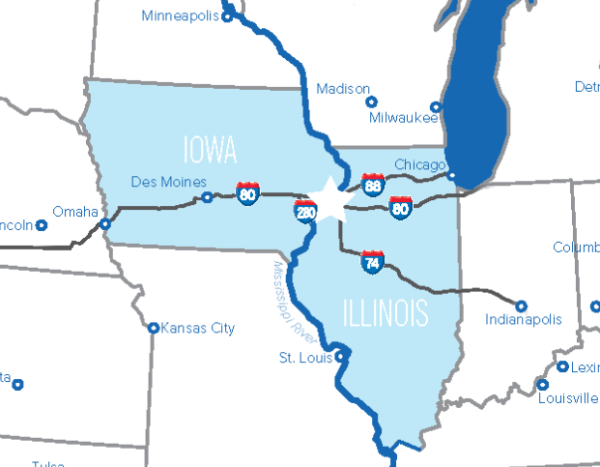
Map of the Quad Cities region
The heart of the Midwest
QC, That's Where? It's where two states and one mighty Mississippi River are home to a family of communities making the Midwest's future.