



Regional Market Summary Q4 2025

"Jobless Boom": U.S. economy continues to deliver strong GDP growth with weak job growth

Written by Bill Polley, Ph.D., Senior Director of Business Intelligence, Grow Quad Cities/Quad Cities Chamber

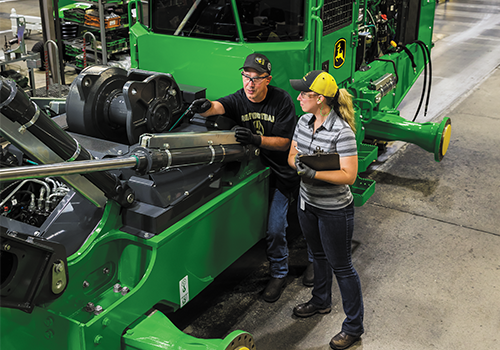
Writers have often used mechanical terms to describe the economy. In a machine, cause leads to effect because of fixed mechanical linkages within the system. In the economy, movements in one variable often seem to have an effect on other variables, much like in a machine. This way of thinking has implications for policy because if you understand how the levers and dials on the machine work, you know which lever to pull to get the desired result.

However tempting it is to use this mechanical metaphor, in the real economy correlation does not always mean causation. Relationships thought to be stable can break down. The current economic environment is exhibiting behavior that does not fit the old models. As a result, policy implications are clouded, and predictions come with more uncertainty. Better explanations are needed, but first we need to describe what has changed and where the old linkages are failing. One of those old linkages is the correlation between GDP growth and employment growth. Simply put, GDP growth has been quite strong while employment growth has lagged--creating a so-called "jobless boom." It is worth spending some time looking at potential explanations for this unusual series of events.

At the time of our last Quarterly Market Report, we did not yet know the real GDP growth rates for the 3rd quarter of 2025 because of the lapse in government appropriations. The Atlanta Fed's nowcast of 4.2% at that time seemed optimistic, with the Blue Chip consensus closer to 3%. One open question was how large the inventory drawdown would be. While this is not always a complicated or consequential issue, answering this question is more complicated today because of the volatility introduced by tariffs. Inventories spiked in advance of the tariffs and have been drawn down over time. As it turned out, inventories were hardly drawn down at all (-0.12%) in the 3rd quarter. Consequently, 3rd quarter real GDP growth came in at a very strong 4.4% (all growth rates of GDP and its components in this report are expressed as a seasonally adjusted annual rate).

Real GDP growth in the 4th quarter was 1.4%, down significantly from the 3rd quarter, but still quite good for the circumstances. The 4th quarter was hampered by the government shutdown at the beginning of the quarter. Federal government spending fell by 16.6% which took 1.15 percentage points off of the overall real GDP growth rate. Without the drop in federal spending, real GDP growth would have been closer to 2.5% which is close to the recent average. Even so, we ended 2025 with 2.2% real GDP growth--slightly less than the 2.8% in 2024 though better than some forecasters would have expected in light of the tariff announcements early in the year.

Consumption spending still the backbone of U.S. economic activity

The story of 2025 was one of mostly strong consumption growth alongside larger fluctuations in business investment, government spending, and net exports. Consumer spending's only real stumble was in the 1st quarter when it grew by only 0.6% and contributed only 0.42 percentage points to GDP. As a result, GDP decreased by 0.6% in that quarter.

In the 4th quarter, consumption increased 2.4%, contributing 1.58 percentage points to GDP growth. This was slightly less than the recent averages. In contrast, investment was slowed down by a 2.4% decrease in nonresidential structures and a 1.5% decrease in residential structures. With the drop in government spending and near zero growth in net exports, consumption--even though it was slightly below average--was the largest contributor to GDP growth.


Slow job growth at odds with GDP growth

Returning to our mechanical metaphor, one linkage that has seemed to be quite solid for decades is the connection between GDP and employment. Throughout most of the post-WWII era, deviations from trend in GDP and employment have been very highly correlated. Conditions that promote faster GDP growth have tended to lead to faster employment growth. Policies meant to stimulate the economy have tended to boost the labor market. It has been such a stable relationship that it has hardly been questioned. Indeed, economic models are evaluated in part on how well they match relationships like this.

The flaw with thinking about the economy in such rigid terms is that while some of these linkages are very persistent, there will come a time when a relationship once thought to be rock-solid starts to fade.

We just finished a year with over 2% real GDP growth, yet from April to December nonfarm payroll employment only increased by 12,000 jobs and three of those months had negative growth. To put things mildly, this is highly unusual. It has complicated the Federal Reserve's monetary policy framework and frustrated economic forecasters.

The chart below illustrates what has changed. Normally, the deviations from trend for real GDP and employment track each other closely. The strong economic growth before 2020 led to both GDP and employment being well above trend. After the COVID-19 recession the pattern changed. Employment initially lagged behind GDP growth, then surged ahead before turning downward again. What is unusual here is that these lines have crossed each other multiple times and moved in opposite directions much more than is typical. After the 4th quarter of 2025, we now have employment moving further below trend while GDP growth is staying very close to trend, giving rise to the phrase "Jobless Boom." The conundrum for the Federal Reserve is whether it is appropriate to cut the policy interest rate to support the labor market when GDP growth is at or above trend.


Is it falling labor demand, or is it a shift in labor supply?

Economic growth, as described earlier, is still quite strong. Stripping away the volatility caused by changes in tariff policy last year, the underlying trend is close to long-run averages. This should lead to equally strong labor growth. That did not happen in 2025, nor does it look like it will in early 2026. Is there an explanation?

Is it that businesses are laying off employees and being reluctant to hire? Certainly that is part of the answer. Over the last year, we have noted the "no hire, no fire" labor market. National data on job openings and layoffs show fewer layoffs than we would expect with such low job growth, and job openings have trended lower. The question is why job openings are decreasing while GDP growth is strong. Some say that adoption of AI is decreasing the demand for some jobs, though it is unlikely that AI can explain all of what we are seeing. 

The demographics of labor supply also matter. The tail end of the Baby Boom generation is nearing retirement, which would suggest more openings in years to come. However, in some areas of the country where population growth is lower, like the Midwest, there are fewer workers entering the labor market, making this a supply issue.

We asked local businesses about this in our Business Outlook Survey. The majority of survey respondents are concerned about the availability of qualified labor. Also, many respondents say that they have hired or are planning to hire more workers.

Is there hard data for the Quad Cities area to support these survey responses? Yes. Data from Lightcast, a labor force analytics company, shows that in the 4th quarter of 2025 (October through December), total job postings in the 6-county Quad Cities combined statistical area were up by about 2.3% from the 4th quarter of 2024. The number of companies hiring was up 29%. Median advertised wages in those job postings were up 5.6%. As additional evidence of healthy activity on both the supply and demand side for labor in the Quad Cities, the duration of postings fell from 27 days in the 4th quarter of 2024 to just 18 days in the 4th quarter of 2025.

While the labor supply concerns should not be ignored, the strength of labor demand is good news for the Quad Cities. We experienced the demand weakness in 2024--before the rest of the country. We are now seeing some recovery although it may end up being a very gradual recovery.

In the meantime, this presents opportunities for companies potentially looking to expand into the Quad Cities area as the strong job posting data suggests an active labor market.


Midwest regional economy again mostly flat in the fourth quarter

Despite the more robust national economic growth data, there were signs of lower than average growth in many Midwestern states in the 4th quarter. The State Coincident Index from the Philadelphia Fed increased by only about 0.1% in Illinois. Iowa's performance was somewhat better with a 0.7% increase. In our last Quarterly Market Report, data was not available for the full 3rd quarter, but those data are now available. For reference, the full 3rd quarter changes in the index were +0.8% (IL) and +0.4% (IA). Thus, for the second half of the year as a whole, Iowa and Illinois turned in nearly identical performances.

The Federal Reserve's Beige Book, which reports on economic conditions in the 12 Federal Reserve districts across the country, noted the following about conditions in the Chicago district (where the Quad Cities is located) in January: "Economic activity in the Seventh District was little changed over the reporting period and contacts expected a slight decline in activity over the next year. Consumer spending and construction and real estate demand rose slightly; employment was flat; nonbusiness contacts saw no change in economic activity; business spending fell slightly; and manufacturing activity declined modestly. Prices rose moderately, wages were up modestly, and financial conditions loosened modestly. Net farm income in 2025 was similar to 2024."

The Weekly State-Level Economic Conditions Index was near the long-run average for Iowa throughout most of the 4th quarter and slightly below the long run level for Illinois.

Source: Christiane Baumeister & Danilo Leiva-León & Eric Sims, 2024. "Tracking Weekly State-Level Economic Conditions," The Review of Economics and Statistics, MIT Press, vol. 106(2), pages 483-504, March.


Conclusion

Taken together, all of this data at both the national and local levels presents a complex picture that does not perfectly align with old models of how different variables are linked. The idea of the economy as a machine with fixed linkages can be useful in some situations but can fall short during times of change. The economy reflects human choices and demographic realities that are not fixed. They may have been stable for some time but are now evolving faster than in years past.

Nationally, economic growth, as measured by GDP is strong, and it is likely to remain near or slightly below trend this year. The weakness in the national labor market reflects changes in demand driven by AI as well as by demographic factors that make the present time truly different from many past episodes.

The Midwest as a region may see slightly slower growth for a time due to greater dependence on manufacturing, which is not growing as quickly as other areas more dependent on the rapidly growing AI and tech-related industries.

Iowa, Illinois and the Quad Cities continue to keep pace with the rest of the Midwest. Demographic factors here (and in the Midwest generally) are different enough from the nation as a whole that labor markets here will not follow national trends perfectly. However, significant opportunities remain because the supply side of the local labor market is flexible. As job posting data shows, hiring can still be brisk, even when overall job growth slows--defying the old, mechanical models of the economy.

Bill Polley
Contact
Bill Polley
Senior Director, Business Intelligence - Grow Quad Cities
Click to View Email
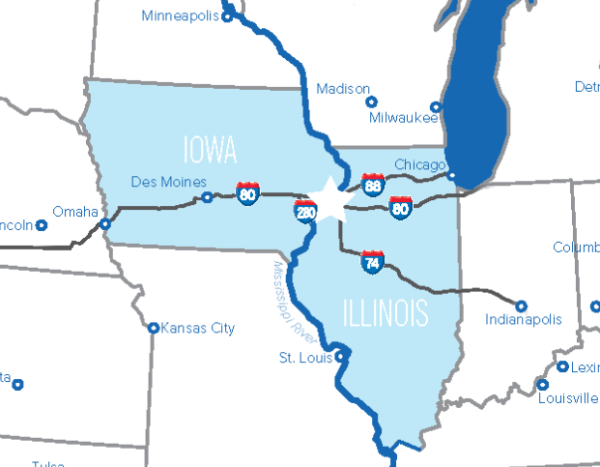
Map of the Quad Cities region
The heart of the Midwest
QC, That's Where? It's where two states and one mighty Mississippi River are home to a family of communities making the Midwest's future.